Tottenham Golden Era: Tottenham VN Guide To Its Legacy
The Tottenham golden era represents the period when sustained domestic success, European breakthroughs, influential players, and an attacking philosophy reshaped the club’s historical identity. Tottenham VN examines its timeline, major figures, defining achievements, tactical foundations, and the evidence supporters can use to understand its enduring significance.
Tottenham golden era historical foundations
The Tottenham golden era is closely associated with Bill Nicholson’s managerial years and the trophy-rich period beginning around 1960. Its foundations combined an established squad, influential signings and an attacking football philosophy.
Defining the era’s historical boundaries
The Tottenham golden era can be understood in two connected timeframes. Its concentrated peak came in the early 1960s, beginning with the 1960–61 Double and continuing through the FA Cup retention in 1962 and European Cup Winners’ Cup success in 1963. A broader interpretation covers Nicholson’s “glory, glory” years through his retirement in 1974.
The foundations reached further back. Nicholson had played in the “push and run” side that won the Second Division in 1949–50 and First Division in 1950–51. He later became manager in October 1958, connecting earlier Tottenham ideas with the successful side of the following decade.
Bill Nicholson’s transformation of the team
Bill Nicholson shaped the Tottenham golden era by combining squad development with an emphasis on attacking, entertaining football. After becoming manager in 1958, he assembled the side that would win the Double and continued strengthening it as Tottenham moved into European competition.
His period can be described through three connected elements:
- Building a settled team around technically and physically complementary players.
- Using attacking football rather than relying primarily on defensive containment.
- Adding players such as Dave Mackay and later Jimmy Greaves to reinforce an already competitive squad.
These elements allowed Tottenham to compete across league, domestic cup and European formats.
Core players behind the successful period
The Tottenham golden era depended on a balanced group rather than one individual. Captain Danny Blanchflower provided tactical influence, Dave Mackay supplied drive in midfield, and John White connected play in attacking areas. Bobby Smith offered a powerful central presence, while Cliff Jones brought pace and goals from wider positions.
Goalkeeper Bill Brown and defenders including Peter Baker, Maurice Norman and Ron Henry formed the defensive structure behind them. Jimmy Greaves joined after the Double season and added another major attacking component. The combination of leadership, creativity, physical strength and finishing ability explains how the squad could function effectively across different competitions.
Achievements that shaped a lasting legacy
The achievements associated with the Tottenham golden era extended beyond one exceptional season. League, FA Cup and European successes created a sequence of trophies under Nicholson across the 1960s and early 1970s.
The 1960–61 league and FA Cup Double
The defining achievement of the Tottenham golden era was the 1960–61 First Division and FA Cup Double. Tottenham began the league campaign with 11 consecutive victories, eventually secured the championship with matches remaining and completed the Double by defeating Leicester City 2–0 at Wembley.
The achievement was historically significant because Tottenham became the first English club in the 20th century to complete the league-and-FA-Cup Double. Bobby Smith and Terry Dyson scored in the FA Cup final, while the wider campaign relied on a notably settled group. The season therefore combined sustained league performance with successful progression through a knockout competition.
Domestic trophies after the historic Double
Domestic success continued after 1961, making the Tottenham golden era more than a single-season story. Tottenham retained the FA Cup in 1962, won the competition again in 1967 and later collected League Cups in 1971 and 1973 under Nicholson.
| Competition | Success | Historical context |
| FA Cup | 1962 | Retained after Double season |
| FA Cup | 1967 | Further cup success |
| League Cup | 1971 | Trophy in later Nicholson period |
| League Cup | 1973 | Second League Cup triumph |
These trophies show how the successful period evolved as personnel changed while Nicholson remained manager.
European breakthrough and continental impact
European competition expanded the significance of the Tottenham golden era beyond English football. After reaching the European Cup semi-finals in 1961–62, Tottenham won the European Cup Winners’ Cup the following season, defeating Atlético Madrid 5–1 in the 1963 final in Rotterdam.
That victory made Tottenham the first British club to win a European trophy. Further continental success arrived with the UEFA Cup in 1972, meaning Nicholson’s Tottenham won two different European competitions during his tenure. These achievements connected the club’s domestic trophy sequence with a growing European identity and extended the period’s historical importance.
How to interpret the era in club history
The Tottenham golden era can be viewed through football style, sustained trophy production and cultural influence. These elements explain why Nicholson’s period occupies such a prominent place in Tottenham’s historical narrative.
Tactical principles behind attacking football
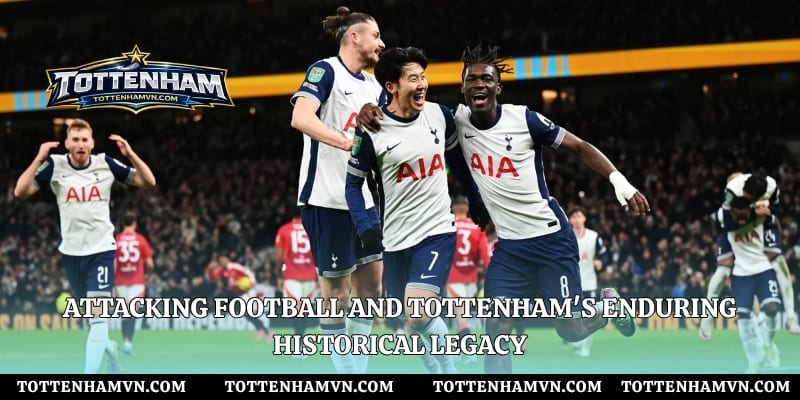
Attacking football was a defining characteristic of the Tottenham golden era. Nicholson’s teams were associated with style, skill and forward intent, while the squad contained players capable of combining physical strength with passing, movement and individual creativity.
The structure relied on complementary qualities. Blanchflower could influence tactical decisions, Mackay contributed midfield power, White found space in attacking areas, and forwards such as Smith, Jones and later Greaves supplied different routes toward goal. Rather than representing one rigid formation or mechanism, the period reflected a broader commitment to proactive football supported by teamwork, fitness and technically capable players.
Trophy records as evidence of sustained success
The trophy sequence gives the Tottenham golden era a measurable historical framework. Under Nicholson, Tottenham won eight major trophies: the First Division championship, three FA Cups, two League Cups, the European Cup Winners’ Cup and the UEFA Cup.
These honours can be grouped into three categories:
- League success represented by the 1960–61 First Division championship.
- Domestic knockout success through the FA Cup and League Cup.
- Continental success through the 1963 Cup Winners’ Cup and 1972 UEFA Cup.
The spread across competitions and years distinguishes a sustained managerial period from the narrower peak represented by the early-1960s team.
Cultural legacy for later generations
The cultural meaning of the Tottenham golden era extends beyond its trophy list. Nicholson’s teams established a historical association between Tottenham and ambitious attacking football, while figures such as Blanchflower, Mackay, Greaves and White became recurring reference points in accounts of the club’s identity.
The period also produced several landmarks that remain central to Tottenham history: the 1961 Double, the first British European trophy in 1963 and another European title in 1972. Together, these achievements created a reference period against which later Tottenham teams and generations of supporters could understand the club’s traditions, playing ideals and place in English and European football history.
>>> Read More: Tottenham chants history: Origins And Meaning | Tottenham VN
Lời kết
The Tottenham golden era is best understood through the connection between major trophies, Bill Nicholson’s leadership, influential players, attacking principles, and European progress rather than through one isolated season. Tottenham VN places these elements together so readers can assess why this period remains a central reference point in the club’s sporting and cultural history.