
Tottenham European Finals: A Historical Guide | Tottenham VN
Tottenham European finals trace a European story shaped by breakthrough victories, two-legged contests, penalty drama and major modern showpieces. Tottenham VN examines the competitions, decisive matches, changing final formats and historical significance, giving readers a clear framework for understanding how each appearance fits into the club’s continental record.
Tottenham European finals across the eras
Tottenham European finals span more than six decades, beginning with continental success in 1963 and extending to the Europa League triumph of 2025. The record covers several UEFA competitions and changing final formats.
1963 Cup Winners’ Cup breakthrough
The first major chapter in Tottenham European finals came in the 1963 European Cup Winners’ Cup. Bill Nicholson’s side faced Atlético Madrid in Rotterdam and won 5–1, becoming the first English club to win a UEFA competition. Jimmy Greaves scored twice in a final that established Tottenham as a continental trophy winner.
Unlike the later UEFA Cup finals involving Tottenham, the 1963 decider was settled in a single match. That distinction is important because it meant there was no return leg or aggregate calculation: the trophy depended entirely on the result in Rotterdam.
UEFA Cup finals from 1972 to 1984
The UEFA Cup period added three appearances to Tottenham European finals. Tottenham defeated Wolverhampton Wanderers in the inaugural UEFA Cup final in 1972 and returned to the final in 1974. A decade later, the club met Anderlecht in the 1984 final and secured another trophy.
These finals used a two-legged system rather than the modern single-match format. The main landmarks were:
- 1972: victory over Wolverhampton Wanderers.
- 1974: final appearance against Feyenoord.
- 1984: victory over Anderlecht.
- 1984: the second leg required a penalty shootout after the aggregate score remained level.
Modern finals from 2019 to 2025
The modern phase of Tottenham European finals includes two contrasting single-match occasions. In 2019, Tottenham reached their first European Cup or Champions League final, facing Liverpool in Madrid. UEFA recorded Tottenham as the 40th club to appear in a European Cup final and a debutant at that stage of the competition.
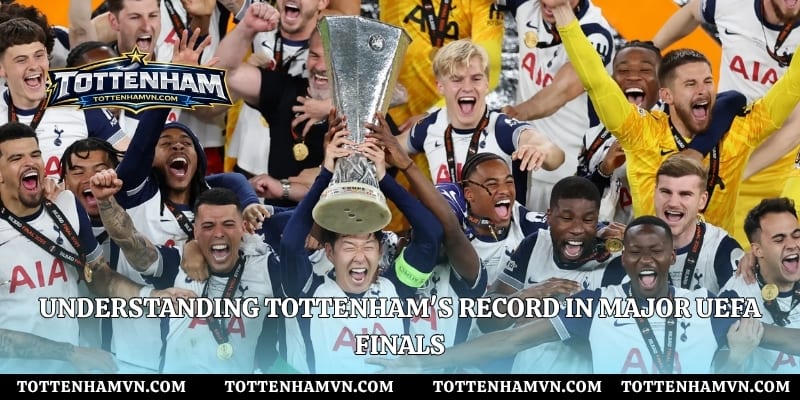
Six years later, Tottenham reached the 2025 Europa League final against Manchester United at San Mamés in Bilbao. Brennan Johnson scored the only goal in a 1–0 victory, giving Tottenham their first European trophy since 1984 and another UEFA Cup/Europa League title.
How Tottenham’s European finals unfolded
The outcomes of Tottenham European finals reflect different mechanisms: single matches, two-legged aggregate ties, extra time and penalties. Understanding those formats explains how each trophy or defeat was ultimately decided.

Decisive scores across each final
Scorelines provide the simplest chronological view of Tottenham European finals, but they must be read alongside the format used in each era. The 1963 Cup Winners’ Cup was settled through a 5–1 win over Atlético Madrid, whereas the 1984 UEFA Cup required two draws followed by penalties.
Modern finals returned Tottenham to single-match deciders. The 2019 Champions League final ended in defeat to Liverpool, while the 2025 Europa League final produced a 1–0 victory over Manchester United. Brennan Johnson’s first-half goal was sufficient in Bilbao because Tottenham protected the advantage through the second half.
Two-legged finals and aggregate outcomes
Two-legged ties are a distinctive feature of the older Tottenham European finals, particularly the UEFA Cup era. Instead of deciding the competition at one neutral venue, finalists played once at each club’s ground, with the combined score determining the winner.
The 1984 final demonstrates the mechanism clearly. Tottenham drew 1–1 away to Anderlecht and then drew 1–1 again after extra time in the return match. With the teams level on aggregate, Tottenham won the subsequent shootout 4–3. Modern Europa League finals operate differently: one match is played at a designated venue, followed by extra time and penalties when required.
Managers and captains shaping the finals
Managers and on-field leaders provide another way to distinguish Tottenham European finals by era. Bill Nicholson managed the breakthrough 1963 Cup Winners’ Cup victory and the 1972 UEFA Cup success, linking Tottenham’s early continental achievements to the same managerial period.
The 1984 UEFA Cup winners were managed by Keith Burkinshaw, with Steve Perryman captaining the first leg and Graham Roberts the second. Mauricio Pochettino managed the 2019 Champions League finalists, while Ange Postecoglou led the 2025 Europa League-winning team. Cristian Romero captained Tottenham in the Bilbao final and was named UEFA’s Player of the Match.
How to interpret Tottenham’s final record
A clear reading of Tottenham European finals separates appearances, victories and competition identities. Tournament names and formats have changed considerably, so historical context helps connect older UEFA Cup campaigns with modern records.
Separating final appearances from trophies
An appearance and a victory represent different categories within Tottenham European finals. Reaching a final records progression to the competition’s deciding stage, while a trophy requires winning that final under the rules used in the relevant season.
Tottenham’s record therefore includes both successful and unsuccessful finals. The 1963 Cup Winners’ Cup and the UEFA Cup successes of 1972 and 1984 belong to the trophy-winning category. The 2019 Champions League campaign belongs to the final-appearance category without a corresponding title. The 2025 Europa League victory added another successful final, with UEFA identifying it as Tottenham’s third UEFA Cup/Europa League title.
Comparing UEFA competitions across eras
Competition identity matters when comparing Tottenham European finals because the club has reached deciding matches in different UEFA tournaments. The European Cup Winners’ Cup was a separate competition, while the UEFA Cup developed into today’s Europa League. The European Cup became the Champions League.
| Competition | Tottenham final era | Format example |
| Cup Winners’ Cup | 1963 | Single-match final |
| UEFA Cup | 1972–1984 | Two-legged finals |
| Champions League | 2019 | Single-match final |
| Europa League | 2025 | Single-match final |
UEFA describes the 2025 competition as the 54th season since the UEFA Cup was introduced, illustrating the historical continuity behind the renamed tournament.
Verifying dates, formats and match records
Accurate records of Tottenham European finals combine the season, competition, opponent, venue and applicable final format. This prevents older two-legged UEFA Cup finals from being treated as though they operated under the same structure as today’s Champions League or Europa League finals.
UEFA’s historical material provides detailed examples. Its UEFA Cup archive records Anderlecht 1–1 Tottenham on 9 May 1984 and Tottenham 1–1 Anderlecht after extra time on 23 May, followed by Tottenham’s 4–3 shootout victory. For the modern era, UEFA records the 2025 final at San Mamés on 21 May and Tottenham’s 1–0 result against Manchester United.
>>> Read More: Tottenham Double 1961: Historic Season With Tottenham VN
Lời kết
Tottenham European finals provide a structured way to understand the club’s continental history, from the 1963 breakthrough and UEFA Cup triumphs to the Champions League stage and 2025 Europa League success. Tottenham VN connects results, formats and historical context so readers can distinguish appearances, victories and defeats while evaluating the record accurately.